Oddur Ingólfsson is full professor at the University of Iceland. His area of research is electron molecule interaction, focusing on the reactive processes of dissociative ionization and dissociative electron attachment. He co-authored over 100 papers in peer-reviewed journals, edited and co-authored a book on electron molecule interaction, and is co-inventor on 6 patents. Prof. Ingólfsson was the coordinator of the Horizon 2020; Marie Sklodowska-Curie Innovative Training Network ELENA -Low energy ELEctron driven chemistry for the advantage of emerging NAno- fabrication methods, and chair of the EU-COST Action CM0601 – Electron Controlled Chemical Lithography (ECCL). He has served on the scientific committee and hosted for several conferences on electron molecule interactions and related topics.
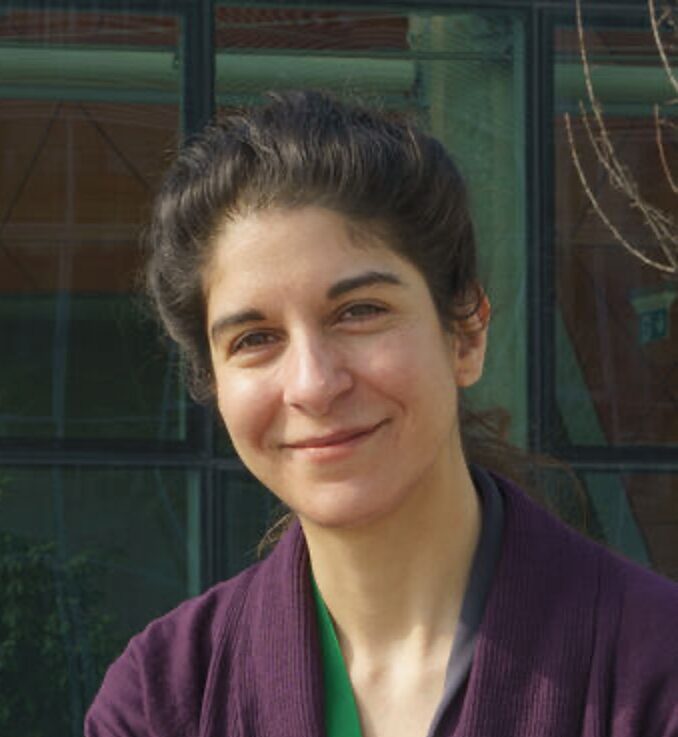
Alessandra Bellissimo’s main research interest concerns the fundamental mechanisms governing electron interaction, generation, and emission from solid surfaces. Her current scientific focus lies in unravelling the electron dynamics of complex many-body processes, in particular of plasmon excitations, which play a pivotal role in secondary electron emission. With a background in Physics from the Technical University in Vienna (AT) and a PhD in Material Sciences, Nanotechnology, and Complex Systems from the University of Roma Tre (IT), Alessandra has explored the field using several spectro- and microscopic techniques; i.a. electron-pair spectroscopy to investigate the correlations between plasmon excitations and the ejection of secondary electrons; scanning field-emission microscopy, which enables to both image the surface topography, and detecting the spectroscopic signal of those electrons escaping the tip-surface tunnel junction. Presently, she leads a project at the Institute of Photonics at TU Wien where time-resolved photoelectron spectroscopy from solid surfaces is employed to establish the causal link between collective electron excitations and SE-emission channels.
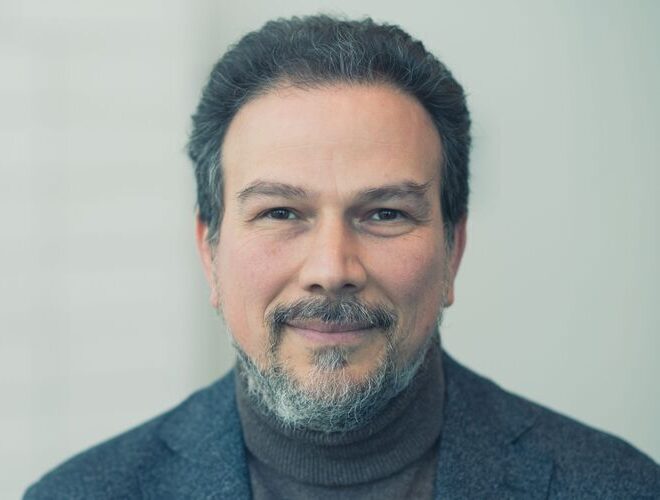
Danilo De Simone is scientific director at imec. He has 24 years of experience in the semiconductor R&D field and his work has produced over 100 scientific and technical papers in the field of lithographic materials and advanced patterning. Before imec, he worked for the industry for STMicroelectronics, Numonyx and Micron Technology. He is editorial board member of the Journal of Micro/Nanopatterning, Materials, and Metrology (JM3), member of SPIE committee for the Patterning Materials and Processes program and member of the International Advisory Board of the Photopolymer Science and Technology Conference (ICPST).
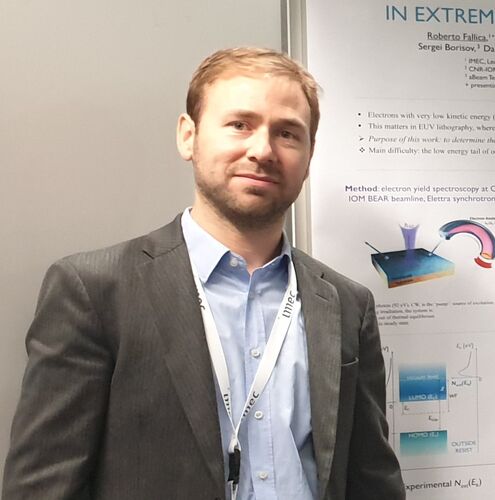
Roberto Fallica received his master’s degree in Electronics Engineering from Politecnico di Milano (Italy) in 2007 and completed the PhD school in Nanotechnology from University of Milano-Bicocca in 2012 with a thesis on the characterization of phase-change chalcogenide nanowires for nonvolatile data storage. In 2014 he was postdoc researcher at the Paul Scherrer Institute (Switzerland) working at the dedicated EUV/X-ray interference lithography and X-ray absorption spectroscopy beamline for characterization and patterning of nanoscale photoresist structures. Since 2018, he is staff researcher in the Advanced Patterning department of IMEC (Belgium). His duties include the screening of lithography materials and stacks to develop the technology that will enable future semiconductor devices in BEOL (back-end of line) such as DRAM (storage layer) and logic (metalization). For this purpose he is focusing on characterization of EUV litho stack materials (photoresist and underlayers) especially for defect mitigation by improving adhesion. In addition, he is in charge of measuring fundamental physical properties of EUV photoresists such as electron blur and electronic processes by photoemission spectroscopy and photocurrent. He is member of SPIE since 2016.
Kees Hagen is associate professor at Delft University of Technology. His area of research is microscopy and lithography with charged particles. He co-authored over 120 papers in peer-reviewed journals, a book on electron-beam-induced nanometer-scale deposition, and 2 patents. In 2006 he organized the first International Workshop on Focused Electron-Beam-Induced Deposition Processing (FEBIP) in Delft, served as chairman of the International Steering Committee of the FEBIP workshops till 2022, was co-chair of the EU-COST Action CM1301 CELINA, conference chair of the 41st International Micro and Nano Engineering conference MNE2015 in the Hague, and is board member of the International Micro and Nano Engineering Society iMNEs.
Jacob Hoogenboom is associate professor and group leader at the Imaging Physics department of Delft University of Technology (NL) and visiting professor at the University of Lausanne (CH). His research focuses on the development and implementation of novel microscopy techniques based on the integration of light and electron microscopy in a single instrument. The interest of his research group is in particular in techniques for life sciences and biomedical applications aimed at multi-scale and correlative imaging and in experimental techniques to better understand charging and damage under electron beam irradiation.
Hubertus Marbach is the head of the R&D division “Repair Processing” at Carl Zeiss SMT GmbH in Roßdorf/Germany. The division is devoted to developing efficient processes to repair masks for semiconductor industry, whereas the mask repair is based on focused electron beam induced processing (FEBIP). Before entering Zeiss in 2019 he was the leader of the work group “Microscopy and Nanolithography” and professor for Physics at the Friedrich-Alexander-University of Erlangen-Nürnberg/Germany with a strong expertise in Physical Chemistry, Surface Science, and particularly FEBIP.
Harald Plank is Associate Professor at the Graz University of Technology in Austria. His research focuses on direct-write nanofabrication using focused electron and ion beams, with particular emphasis on additive 3D nanoprinting. He has contributed to the fundamental understanding of beam-induced processes and their translation into reliable, application-driven nanomanufacturing concepts. A central aim of his work is to exploit true three-dimensional fabrication freedom to address scientific questions that are difficult or inaccessible with conventional fabrication technologies. This knowledge is further translated into real-world applications, such as advanced 3D nanoprobes, bridging basic science and industrially relevant technologies through predictable, precise, and transferable fabrication strategies.
Petra Swiderek is full professor of Physical Chemistry at the University of Bremen in Germany since 2003. Her scientific interests concern the fundamental understanding of electron-molecule interactions and the resulting chemical reactions on surfaces and in molecular ices. A particular focus is on the role of electron-induced and thermal surface reactions in state-of-the-art nanofabrication processes. Prof. Swiderek is a co-author of over 100 peer-reviewed publications and has coordinated the EU COST Action CM1301 Chemistry for ELectron Induced NAnofabrication (CELINA) which aimed at the development of novel precursor molecules for focused electron beam induced deposition.